Key Highlights
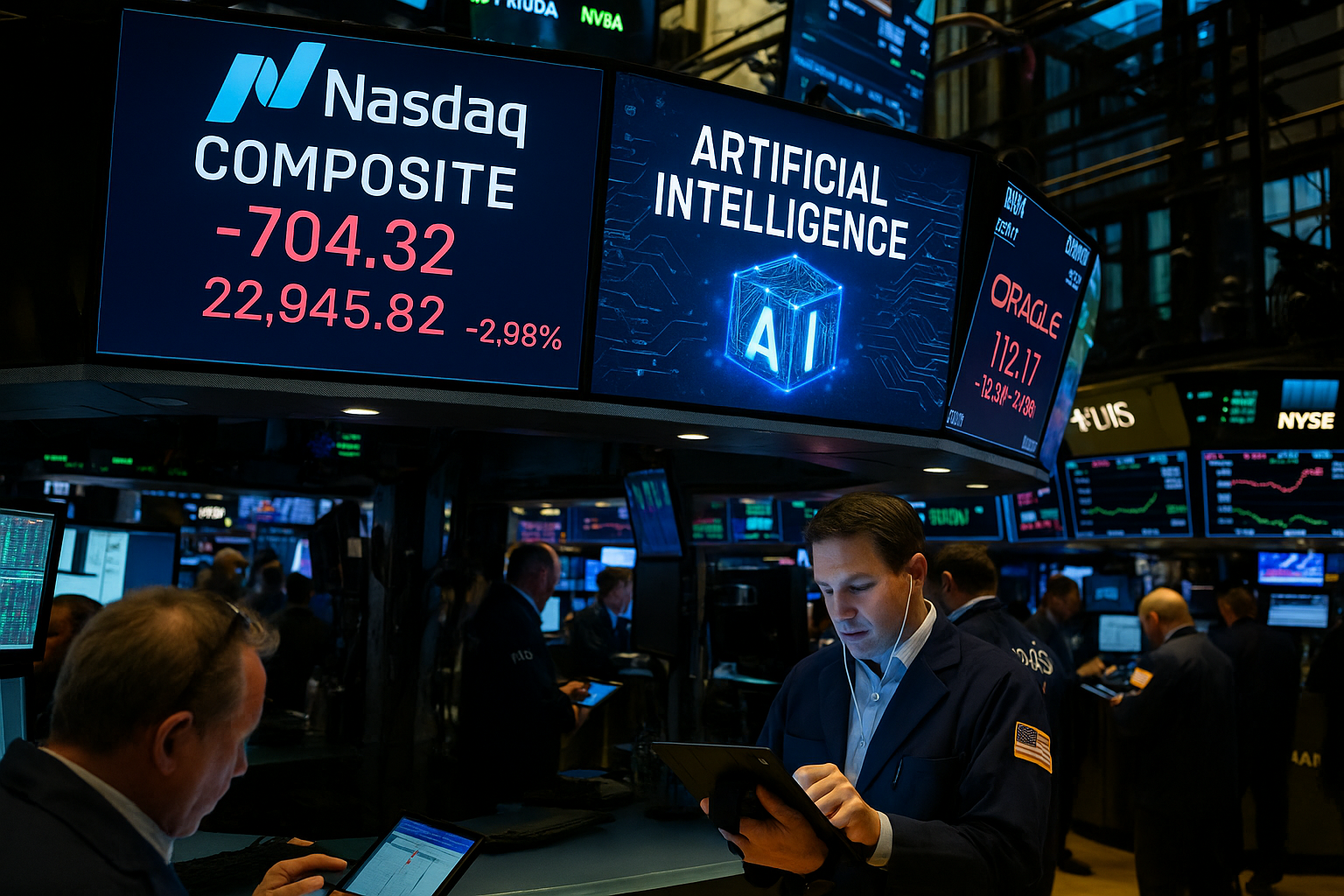
- Nasdaq Composite falls 3.04%, marking its worst week since April 2025.
- AI leaders Nvidia, Palantir, and Oracle post steep declines.
- Market volatility surges as investors reassess inflated tech valuations.
- Ongoing U.S. government shutdown adds to market uncertainty.
- Analysts see potential long-term buying opportunities amid the dip.
Introduction
The Nasdaq Composite suffered its steepest weekly decline since April 2025, falling 3.04% as concerns about inflated AI stock valuations rattled investors.
While the S&P 500 managed a modest 0.13% gain on Friday, the broader mood across Wall Street was marked by fear and caution, with CNN’s Fear and Greed Index plunging to “extreme fear” levels.
The selloff signals a growing skepticism about whether the artificial intelligence boom — long hailed as the market’s main growth engine — can continue to deliver outsized returns.
AI Stocks Lose Momentum
After months of bullish enthusiasm, the AI sector is showing cracks.
Nvidia (NVDA) tumbled 7.1%, Palantir (PLTR) lost 11.2%, and Oracle (ORCL) slid nearly 9% for the week, erasing most of its gains since announcing a major deal with OpenAI in September.
“The market’s bar for positive surprises has risen dramatically,” said Scott Wren, senior global equity strategist at Wells Fargo Investment Institute.
He added that valuations in AI “have percolating concerns under the surface,” echoing similar remarks from the CEOs of Goldman Sachs and Morgan Stanley.
Nasdaq Sentiment Turns Cautious
The CBOE Volatility Index (VIX) spiked as much as 16% midweek before closing flat, signaling heightened uncertainty.
Market strategists noted that the so-called “Magnificent Seven” — the group of leading U.S. tech firms — have become “vulnerable to profit-taking” after months of relentless gains.
“Sentiment and positioning have certainly become stretched,” said Garrett Melson of Natixis Investment Managers Solutions. “Some early yellow flags are appearing around circular and debt financing, but much of the panic seems overdone.”
Despite the pullback, analysts emphasize that a correction could ultimately prove healthy, resetting valuations and paving the way for more sustainable growth.
OpenAI Controversy Adds to Market Jitters
Fueling additional anxiety was OpenAI, whose executives this week walked back earlier remarks suggesting that government support might be necessary to fund its projected $1.4 trillion in AI infrastructure and chips.
“This episode reminded investors that the AI economy is still expensive and uncertain,” noted Mike O’Rourke, chief strategist at JonesTrading.
“Every major U.S. tech firm celebrating deep ties with OpenAI has also invited a new level of financial unpredictability into their forecasts.”
Government Shutdown and Economic Pressure
The U.S. government shutdown, now the longest in history, has compounded investor worries.
Consumer sentiment fell to its lowest level since June 2022, according to the University of Michigan’s latest survey, with many Americans citing financial insecurity and political dysfunction.
Lawmakers are under pressure to strike a deal before the Thanksgiving travel season, as delays in SNAP benefits and public services mount.
While investors are buying the dip in anticipation of a resolution, prolonged uncertainty could weigh further on markets.
Analysts: Volatility Brings Opportunity
Despite heightened volatility, some strategists see silver linings.
“Long-term investors may find buying opportunities if the S&P 500 experiences a deeper drawdown,” said Wren of Wells Fargo.
Larry Adam, chief investment officer at Raymond James, echoed that optimism, arguing that “volatility often precedes value” in cyclical markets.
Conclusion
The AI rally’s wobble marks a crucial turning point for markets that have ridden a wave of technological optimism for nearly two years.
As investors recalibrate expectations and political uncertainty lingers, analysts agree on one thing: volatility is back — and it’s here to stay.
Still, for disciplined investors, this AI correction might not be the end of the story, but the beginning of a more sustainable tech cycle.