Key Highlights
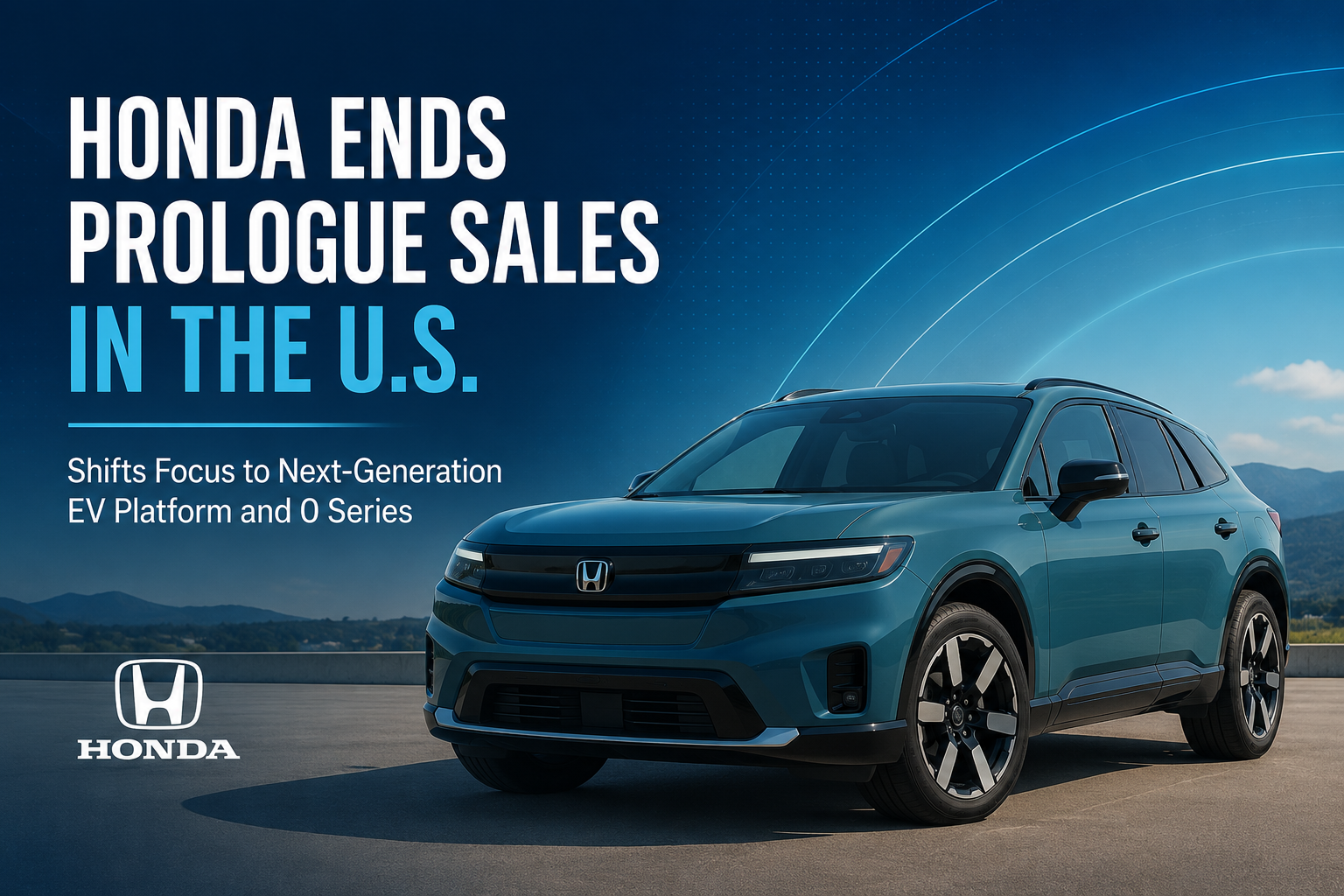
- Honda will end Prologue sales in the U.S. after the 2026 model year.
- The Prologue was developed with General Motors using the Ultium platform.
- Honda plans to replace it with future EVs built on its in-house 0 Series architecture.
- The company says the new platform will improve efficiency, software integration, and manufacturing flexibility.
- The Prologue served as a bridge product while Honda prepared its long-term EV lineup.
Introduction
Honda is preparing for a major shift in its U.S. electric vehicle strategy by ending sales of the Prologue after the 2026 model year. Although the Prologue became one of Honda’s fastest-selling EVs and ranked among the top-selling electric models in the country, the company always treated it as a temporary bridge rather than a permanent pillar of its EV business. Now Honda is moving into the next phase, one centered on vehicles designed in-house and built around its own dedicated electric architecture.
Honda Will End Prologue Sales After 2026
Honda has confirmed that it will stop selling the Prologue in the United States after the 2026 model year. That decision will remove the only electric vehicle currently in Honda’s U.S. lineup and close a short but important chapter in the automaker’s entry into the American EV market.
The timing matters because the Prologue has performed well enough to gain traction with buyers. Even so, Honda is choosing strategy over short-term momentum, signaling that the company sees greater long-term value in moving quickly toward its next platform rather than extending the life of a transitional model.
The Prologue Was Always a Bridge Product
The Prologue was developed in partnership with General Motors and built on GM’s Ultium platform. That arrangement allowed Honda to enter the North American EV market faster while continuing to work on its own dedicated electric technology in the background.
This matters because it explains why Honda is willing to retire a relatively successful product. The Prologue helped the company establish dealer familiarity, gain customer feedback, and build an initial EV presence without waiting for its in-house platform to be ready. In other words, the Prologue did the job Honda intended it to do.
Honda Now Wants Full Control Over Its EV Future
Honda’s next electric vehicles for North America will be built on the Honda 0 Series, the company’s own EV platform. Honda says this architecture will give it stronger efficiency, better software integration, and greater manufacturing flexibility.
That shift is central to the company’s long-term strategy. By designing and engineering future EVs in-house, Honda can reduce its dependence on outside partners and create a more unified product roadmap across markets. That gives the company more control over how it develops vehicles, manages costs, and differentiates its electric lineup.
Why the 0 Series Matters More Than the Prologue
The 0 Series is not just a replacement for one model. It is the foundation of Honda’s next generation of EVs. The company wants this platform to support a broader family of vehicles and provide a consistent architecture for software, efficiency, and production.
That makes the Prologue’s exit easier to understand. Honda is not walking away from EVs. It is trying to move from an outsourced first step to a more scalable and self-directed electric strategy. The 0 Series represents the part of the plan that Honda sees as permanent.
Honda Is Streamlining Product Development
Ending the Prologue also reflects Honda’s broader effort to simplify product development and unify its global EV strategy. A single in-house architecture can help the company reduce complexity, coordinate future launches more effectively, and align technology across regions.
For automakers, that kind of integration matters more as software, battery systems, and manufacturing platforms become central to competitiveness. Honda appears to be prioritizing internal coherence over maintaining a stopgap model that no longer fits its longer-term structure.
The Prologue Still Gave Honda Valuable EV Experience
Even with its short production run, the Prologue offered Honda several strategic benefits. It gave the company real-world exposure to the fast-changing EV market, helped its dealer network learn how to sell and support electric vehicles, and gave buyers a reason to engage with Honda’s electrification story before the 0 Series arrives.
That experience may prove more valuable than the vehicle’s lifespan suggests. In a market where EV adoption depends on product quality, dealer readiness, and consumer trust, bridge models can play an important role even when they are not meant to last.
Honda’s EV Transition Still Carries Risk
The move also creates a short-term gap. Once Prologue sales end, Honda will be left without an EV in the U.S. market until the 0 Series begins to arrive. That creates some risk in a sector where product continuity matters and competitors keep expanding their electric portfolios.
Honda is effectively betting that its next-generation lineup will justify the interruption. That may work if the 0 Series delivers meaningful improvements and arrives on schedule, but it also raises pressure on the company to execute well in its next phase.
Hydrogen Survives, but in a Different Role
The broader strategy described in the shared material also suggests Honda is keeping hydrogen alive, though not in passenger cars. Instead, the company appears more willing to position hydrogen in stationary power and other non-consumer applications.
That signals a narrowing of Honda’s alternative-energy focus. Rather than trying to spread resources across every possible pathway, the company seems more intent on defining EVs as the center of its consumer future while using hydrogen more selectively.
Conclusion
Honda’s decision to end Prologue sales after 2026 marks the end of its first U.S. EV bridge product and the beginning of a more self-directed electric era. The Prologue helped Honda gain market experience and establish an EV presence, but the company now wants to move fully toward its own 0 Series architecture. The transition carries some near-term risk, especially if it leaves Honda temporarily without an EV in the U.S. lineup, but it also shows a company trying to build a more coherent and competitive long-term platform for the next stage of electrification.