Key Highlights
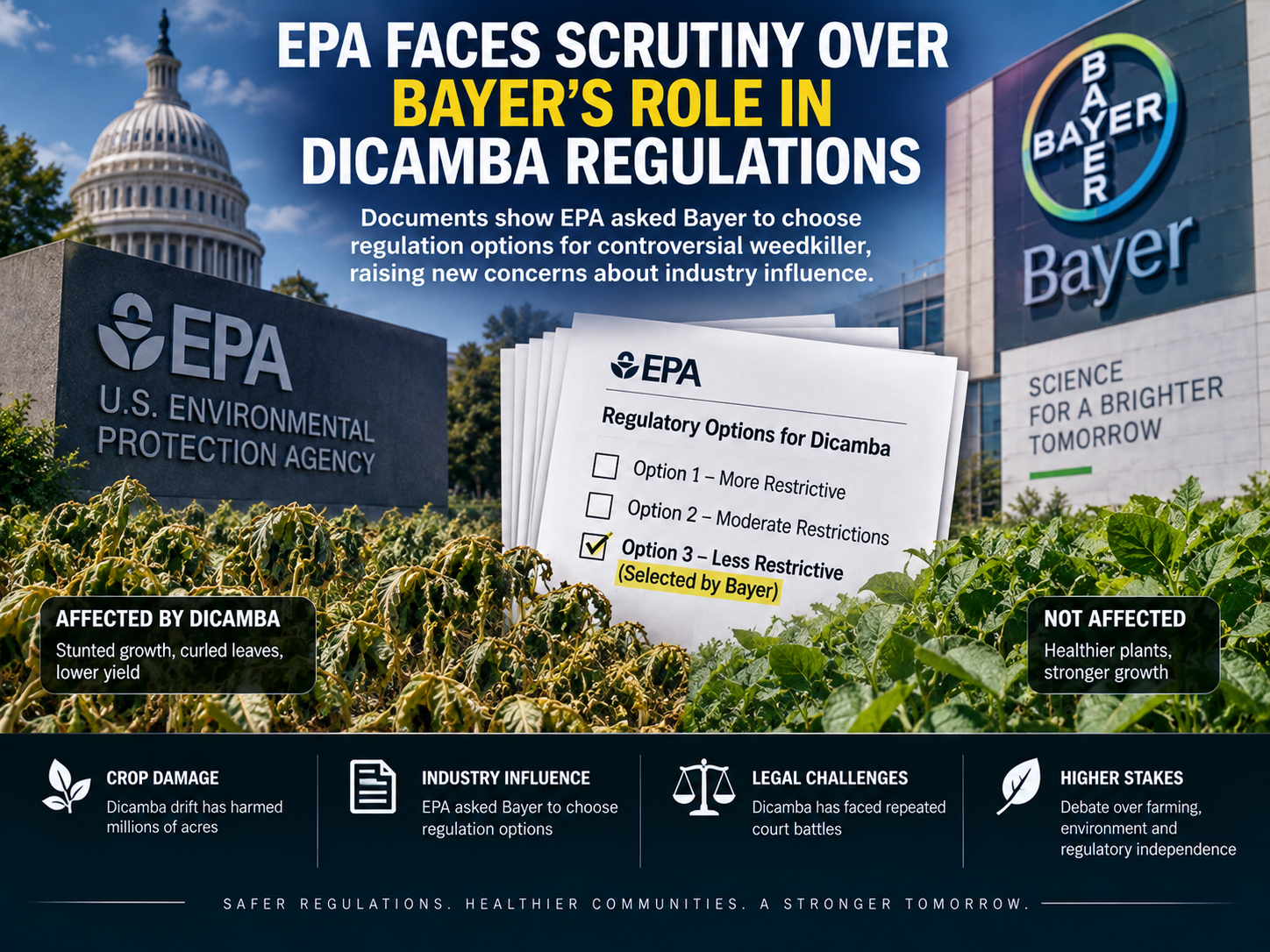
- Newly released internal documents show the US Environmental Protection Agency asked Bayer to choose among several regulatory options for the herbicide dicamba.
- Records show Bayer selected the least restrictive option for one mitigation measure and a middle option for another.
- EPA later included several of Bayer’s preferred choices in a proposed federal rule, according to the documents.
- The EPA said manufacturers are routinely consulted during pesticide rulemaking and maintained that registrants do not dictate regulatory terms.
- Dicamba has faced repeated legal challenges because of its tendency to drift beyond treated fields and damage surrounding crops and vegetation.
- Environmental groups argue the documents show excessive industry influence over pesticide regulation, while the EPA says the process reflects normal regulatory consultation.
EPA and Bayer Face New Questions Over Dicamba Regulation
The US Environmental Protection Agency is facing renewed scrutiny over how it developed proposed restrictions for dicamba, a widely used but controversial herbicide associated with extensive crop and vegetation damage.
Internal agency documents released through ongoing litigation show that EPA officials presented Bayer with several possible regulatory approaches and asked the company which measures it preferred.
The records provide an unusually detailed look at negotiations between the EPA and a pesticide manufacturer during the development of federal rules.
According to the documents, the agency later incorporated several of Bayer’s preferred choices into its proposed dicamba regulations.
The EPA, however, disputes the suggestion that Bayer controlled the process.
The agency says consulting pesticide manufacturers is a normal part of developing mitigation measures and maintains that companies do not dictate the final regulatory requirements.
What Is Dicamba?
Dicamba is an herbicide used to control broadleaf weeds in agricultural crops.
It has become particularly controversial because the chemical can move away from the fields where it is applied.
This phenomenon, known as drift or volatility, can expose nearby crops, orchards, gardens, trees and native vegetation.
The source material states that dicamba drift has damaged millions of acres of farmland and other vegetation since newer uses of the herbicide were approved beginning in 2016.
Courts have also intervened repeatedly in disputes involving dicamba registrations.
The controversy has made the herbicide one of the most closely watched pesticide-regulation cases in the United States.
Documents Show EPA Asked Bayer to Select Mitigation Options
The newly disclosed records focus on discussions between the EPA and Bayer over ways to reduce dicamba’s environmental impact.
During a May 2025 meeting, EPA officials presented Bayer with two possible measures aimed at reducing volatility.
One option would have prohibited applications when temperatures exceeded 85 degrees Fahrenheit.
A less restrictive option would have allowed applications at temperatures up to 95 degrees Fahrenheit if farmers reduced the acreage being treated.
The EPA also offered three possible approaches for reducing dicamba runoff.
Internal correspondence then indicated that officials expected Bayer to provide feedback on which mitigation options it wanted to pursue.
Bayer Chose the Less Restrictive Temperature Option
Eight days after the EPA presentation, a Bayer representative responded with the company’s preferred approach.
Bayer selected the less restrictive volatility option.
That approach would permit dicamba applications at temperatures of up to 95 degrees Fahrenheit provided that the area treated with the herbicide was reduced.
The company also requested another option that the EPA had not originally presented.
That proposal would allow full-field applications at higher temperatures when dicamba was not mixed in the same tank with other products.
According to the released documents, the EPA incorporated both requests into the proposed rule.
The agency also adopted Bayer’s preferred runoff mitigation option.
Environmental Groups Say the Process Went Too Far
The records were released in litigation brought by the Center for Biological Diversity and the Center for Food Safety.
Environmental advocates argue that the documents show the EPA gave Bayer excessive influence over how its own product would be regulated.
Nathan Donley, environmental health science director at the Center for Biological Diversity, said negotiations between pesticide manufacturers and regulators are normal but argued that the exchange reflected in the documents went beyond appropriate consultation.
The groups contend that regulatory restrictions should be determined independently by the agency based on environmental and public-health considerations.
Their lawsuit also argues that the current dicamba approval provides weaker protections against drift than earlier versions.
EPA Says the Regulatory System Worked as Intended
The EPA rejects the characterization that Bayer was allowed to regulate itself.
An agency spokesperson said pesticide manufacturers are routinely consulted because regulators need to understand how proposed restrictions would affect the practical use of a product.
The EPA said companies are permitted to propose mitigation measures that preserve product utility while addressing identified risks.
At the same time, the agency said it independently develops its own regulatory options.
The EPA emphasized that manufacturers do not have final authority over the rules.
That disagreement is now at the center of the controversy.
Critics see the documents as evidence of excessive industry influence.
The EPA sees them as evidence of standard regulatory consultation.
Why Dicamba Has Been So Controversial
Dicamba’s regulatory history has been shaped by its tendency to move beyond its intended target.
When the herbicide drifts onto sensitive plants, it can cause curled leaves, stunted growth and reduced yields.
Farmers growing crops that are not resistant to dicamba have reported damage after neighboring fields were treated.
Concerns have extended beyond commercial agriculture.
Reports cited in the source describe damage to orchards, vegetable farms, home gardens, native vegetation, trees and wildlife areas.
That history has made decisions over application temperatures, acreage restrictions and runoff controls particularly consequential.
Courts Have Previously Challenged Dicamba Approvals
Dicamba has also faced significant legal challenges.
The source material notes that courts have twice ordered the herbicide off the market over concerns related to drift before regulators later approved it again.
Those cases have increased scrutiny of the EPA’s review process.
Environmental groups argue that repeated reports of crop damage demonstrate the need for stronger restrictions.
Agricultural producers and pesticide manufacturers, meanwhile, have argued that dicamba remains an important weed-control tool when used according to approved requirements.
The current dispute therefore reflects a broader policy question.
Regulators must balance agricultural utility against environmental, economic and potential health risks.
Bayer’s Influence Becomes the Central Issue
The latest documents shift the focus away from dicamba’s scientific and agricultural effects alone and toward the process used to regulate it.
The central question is how much influence a pesticide manufacturer should have when regulators are deciding restrictions on that company’s own product.
Industry consultation is common in federal rulemaking.
Manufacturers often possess technical information about how products are formulated, applied and used commercially.
Critics argue, however, that regulators must maintain enough independence to ensure that public-interest protections are not weakened by commercial considerations.
The Bayer-EPA correspondence has intensified that debate because the agency explicitly presented regulatory options and requested the company’s preferred path forward.
Industry Experience Inside the EPA Draws Additional Scrutiny
The controversy also comes amid criticism from environmental groups over the professional backgrounds of senior officials in the EPA’s chemicals and pesticides programs.
The source reports that several senior positions within the EPA toxics office are held by former chemical-industry officials.
Critics argue those relationships create risks of regulatory capture.
The EPA and industry representatives have generally maintained that private-sector experience can provide valuable technical knowledge and does not itself demonstrate improper influence.
The disclosed dicamba documents have nevertheless given critics new material for challenging how the agency manages relationships with regulated companies.
What the Dicamba Dispute Means for Farmers
The outcome matters directly to farmers.
Stricter limits could reduce when and how extensively dicamba can be applied.
That could make weed management more difficult for producers who rely on dicamba-resistant crop systems.
Less restrictive rules, however, may increase concerns among neighboring farmers whose crops are vulnerable to dicamba exposure.
The dispute therefore divides agricultural interests as well as regulators and environmental groups.
Farmers using dicamba want predictable access to an effective weed-control product.
Farmers vulnerable to off-target damage want stronger safeguards against drift.
The EPA must attempt to accommodate both concerns while meeting federal pesticide-safety requirements.
The Broader Question of Regulatory Independence
The dicamba controversy could have consequences beyond a single herbicide.
Federal agencies routinely consult regulated industries when developing technical rules.
Such consultation can provide useful information about costs, implementation and feasibility.
But the new documents raise a more difficult question about where consultation ends and excessive influence begins.
Environmental groups involved in the litigation argue that Bayer effectively selected important elements of its own regulatory restrictions.
The EPA says it remained the ultimate decision-maker and that consultation with registrants is built into the regulatory process.
Determining whether the process complied with federal law will now depend partly on the continuing litigation.
Conclusion
Newly released documents have placed the relationship between the EPA and Bayer at the center of the debate over dicamba regulation.
The records show that federal regulators presented Bayer with several mitigation options, asked the company which approaches it preferred and later incorporated multiple Bayer-supported measures into a proposed federal rule.
Environmental groups argue that the process gave the pesticide manufacturer too much influence over restrictions governing its own product.
The EPA strongly disputes that interpretation and says consulting manufacturers is part of the normal regulatory process, while emphasizing that companies do not dictate final rules.
Behind the procedural controversy is a longstanding agricultural dispute.
Dicamba remains valuable to some farmers for weed control, but its tendency to move beyond treated fields has generated years of complaints, litigation and regulatory challenges.
The central issue now extends beyond dicamba itself.
The case raises a broader question about how closely federal regulators should work with the industries they oversee — and how agencies can obtain necessary technical input without undermining public confidence in the independence of the regulatory process.