Key Highlights
- Amazon “About You” feature creates personalized customer profiles based on activity across its shopping ecosystem.
- The profiles can draw information from purchases, searches, saved lists, product reviews and interactions with the Alexa for Shopping assistant.
- Amazon uses these observations to improve product recommendations and help customers find products that better match their needs.
- Profiles can contain dozens of individual observations about a shopper, including household composition, pets, food preferences, clothing habits and product interests.
- Some inferences appear remarkably accurate, while others can misinterpret purchases made for spouses, children or other household members.
- Customers can review, modify or remove information contained in their About You profiles.
- The feature provides a revealing look at how online shopping activity can be transformed into assumptions about a person’s lifestyle and household.
Amazon’s “About You” Feature Shows What the Company Thinks It Knows About You
Amazon has spent decades learning what its customers buy.
Now shoppers can see some of what the company thinks those purchases say about them.
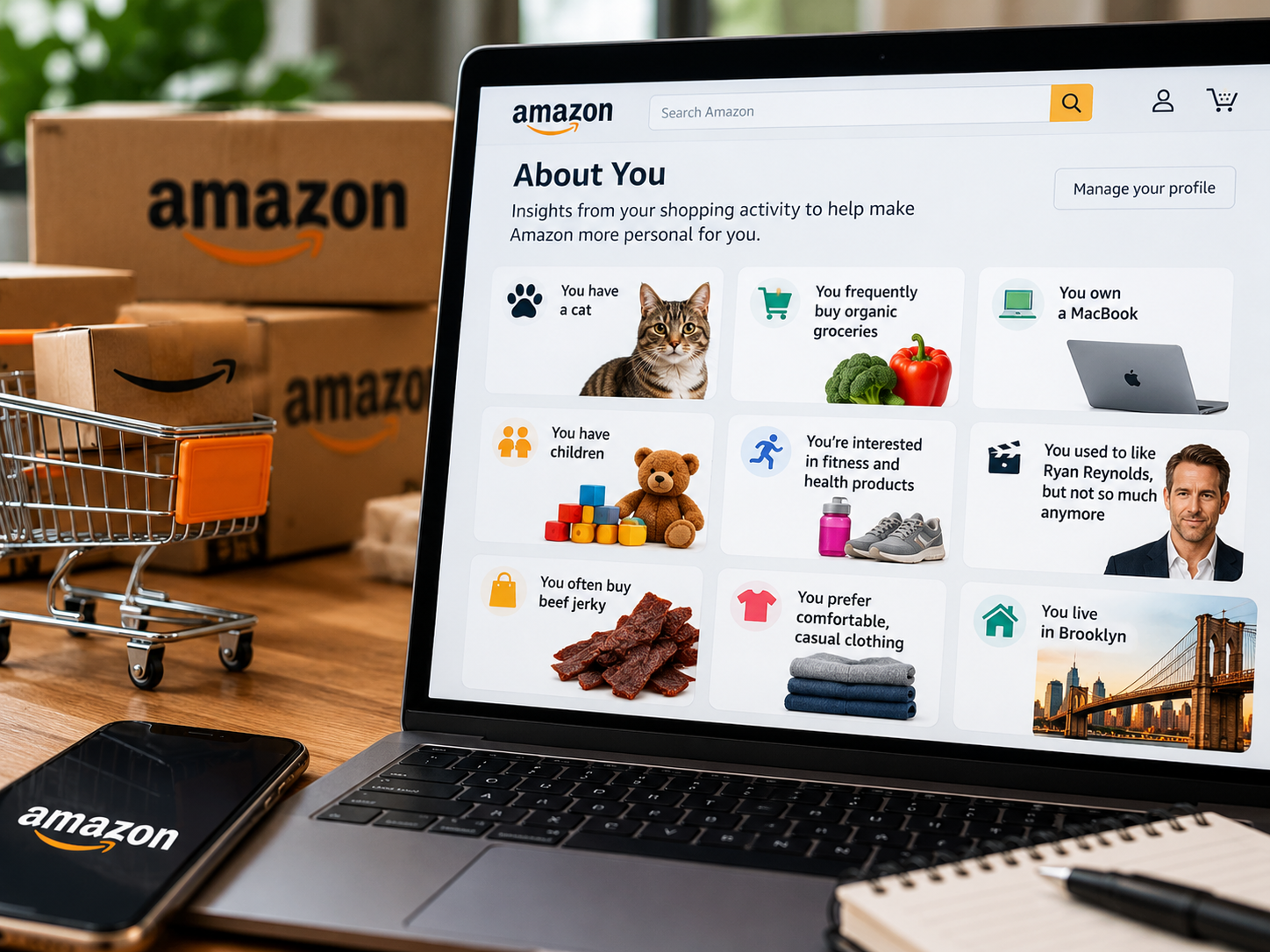
Amazon’s “About You” feature creates a personalized profile containing observations inferred from a customer’s activity across the company’s shopping ecosystem.
These observations can range from relatively straightforward conclusions, such as whether someone owns a cat or frequently buys particular groceries, to surprisingly personal assumptions about clothing preferences, household members and lifestyle.
The results can be impressively accurate.
They can also be hilariously wrong.
That combination has turned Amazon’s About You page into an unexpected source of online entertainment while also offering a rare glimpse into how one of the world’s largest retailers interprets customer data.
What Is Amazon’s “About You” Page?
Amazon launched About You in May as a way to improve personalization for shoppers.
The feature functions almost like a customer profile built from signals collected through interactions with Amazon.
Those signals can include:
- Marketplace searches
- Purchase history
- Saved shopping lists
- Product reviews
- Interactions with Alexa for Shopping
Amazon then uses that information to generate observations about the customer.
The objective is practical.
If Amazon understands that someone owns a particular device, has a pet, buys certain foods or prefers specific types of products, the company can theoretically recommend more relevant items.
But translating transactions into conclusions about people is not always straightforward.
Amazon Can Make Dozens of Observations About One Customer
Users examining their About You pages have found surprisingly detailed profiles.
According to Business Insider employees who reviewed their own accounts, Amazon commonly generated somewhere between approximately 30 and 45 observations about each customer.
Some observations involved straightforward shopping behavior.
Others attempted to interpret what those purchases revealed about the person behind the account.
That distinction is important.
Knowing that someone bought cat food is relatively simple.
Determining whether that person owns one cat, two cats or bought the food for someone else requires an inference.
That is where Amazon’s profiles can become considerably less reliable.
Amazon Often Gets Shopping Habits Right
Amazon appears particularly effective at identifying patterns based on frequent purchases.
Customers reported that the system correctly recognized pets, computers they owned, preferred groceries and some household preferences.
One Business Insider journalist found Amazon had accurately characterized her as someone who preferred glass food-storage containers and organic produce.
Another employee discovered that Amazon associated his account heavily with bathroom-safety products.
There was a straightforward explanation.
He had previously needed a shower chair while recovering from an Achilles tendon injury.
From Amazon’s perspective, repeated or unusual purchases become signals.
From the shopper’s perspective, however, those purchases may represent temporary circumstances rather than permanent characteristics.
Shared Amazon Accounts Can Confuse the System
One of the clearest weaknesses involves shared accounts.
Many households use a single Amazon account for multiple people.
That makes identifying who actually wants or uses each product considerably more difficult.
A purchase could be for a spouse.
It could be for a child.
It could be a birthday present.
It could simply be something ordered on behalf of a friend or relative.
Amazon’s profile nevertheless has to interpret those transactions somehow.
One Business Insider editor who shares an account with his wife said Amazon correctly determined that he owned a cat and a MacBook.
But it concluded that the household had only one cat, overlooking a second pet entirely.
The example illustrates a fundamental problem with behavioral profiling.
The transaction itself may be accurate while the explanation behind it is wrong.
Amazon Can Get Family Details Wrong
Household composition appears to be another difficult area.
Several users reported that Amazon incorrectly estimated how many children they had.
In another particularly unusual example, Amazon reportedly concluded that an editor had a girlfriend named “Barry.”
These mistakes demonstrate how algorithms can connect signals correctly but reach the wrong human conclusion.
If an account repeatedly buys children’s clothing, toys and school supplies, the system may reasonably infer that children are present.
Determining precisely how many children live in the household is considerably harder.
Similarly, products associated with multiple people can blur distinctions between spouses, partners, children and other relatives.
Some Amazon Inferences Become Surprisingly Personal
Other observations go considerably beyond identifying products or household members.
One user discovered that Amazon believed she “used to like Ryan Reynolds, but not so much anymore.”
Others sharing their profiles online reportedly found conclusions about physical characteristics, including observations about body shape.
These examples have helped make About You a social-media curiosity.
Seeing a retailer summarize someone’s lifestyle can feel very different from simply receiving a recommended product.
The underlying information may come from ordinary shopping behavior, but presenting it as a description of the customer makes the extent of personalization much more visible.
Why Amazon Builds Customer Profiles
Personalization is enormously valuable in e-commerce.
Amazon offers an extraordinary number of products.
Helping customers navigate that inventory requires the company to predict which products are most likely to interest each shopper.
A more detailed profile potentially improves those predictions.
If Amazon knows someone owns a cat, recommendations for cat products become more useful.
If it understands which computer or smartphone a customer owns, it can recommend compatible accessories.
If it identifies frequently purchased groceries, it can make repeat purchases easier.
About You essentially exposes part of the information used to make personalization more effective.
Amazon Is Turning Transactions Into Context
The most interesting aspect of About You may be the transition from transaction data to contextual information.
A purchase history tells Amazon what someone bought.
A profile attempts to answer a more complicated question.
Why did they buy it?
That requires connecting individual transactions into patterns.
Repeated purchases of pet supplies might suggest pet ownership.
Children’s products could indicate a family.
Specialized household equipment could indicate a temporary need or a longer-term lifestyle characteristic.
Entertainment purchases could suggest changing interests.
The more activity a customer generates, the more signals Amazon potentially has for building those conclusions.
The Feature Highlights the Limits of Algorithmic Profiles
Amazon’s incorrect conclusions are funny, but they also illustrate an important limitation of automated personalization.
Consumer data describes behavior.
Behavior does not always reveal intent.
Buying beef jerky does not necessarily mean someone particularly likes beef jerky.
Buying women’s clothing does not establish who wears it.
Ordering toys does not reveal exactly how many children live in a home.
Purchasing medical or accessibility products does not necessarily describe someone’s long-term health needs.
Recommendation systems therefore operate with probabilities rather than complete knowledge.
An algorithm may identify a strong pattern without understanding the circumstances that created it.
Customers Can Correct Amazon
Amazon allows users to review and adjust information contained in the About You profile.
Customers can update details or remove observations that do not accurately describe them.
That gives shoppers some control over how Amazon interprets their behavior.
It could also improve future recommendations.
Correcting an inaccurate assumption potentially prevents the platform from continually recommending products based on a conclusion that was never true.
This makes About You different from personalization systems that operate entirely in the background.
Amazon is exposing at least part of the profile directly to users.
About You Raises Broader Privacy Questions
The feature also provides a useful reminder of how much information ordinary online activity can reveal.
Most individual purchases appear harmless in isolation.
Taken together, however, years of transactions can produce a detailed picture of a household.
Shopping data may reveal pets, hobbies, technology ownership, favorite foods, family circumstances and purchasing habits.
Searches, reviews and saved lists add additional context.
Interactions with shopping assistants can provide even more signals.
About You makes those connections visible in a way traditional recommendation systems usually do not.
For some customers, that transparency may be useful.
For others, seeing dozens of personal conclusions generated from shopping activity may feel uncomfortable.
Why Amazon Sometimes Knows More Than Customers Expect
Amazon’s ability to make accurate observations is partly a consequence of frequency.
Shopping behavior produces repeated signals.
Someone may not remember how often they purchased a particular category of product over several years.
Amazon does.
That gives the company an unusual perspective on customer behavior.
A person might think they occasionally buy a product while their transaction history reveals that it appears repeatedly.
In that sense, some surprising About You observations may be accurate precisely because Amazon evaluates behavioral patterns rather than relying on a customer’s own memory.
Why Amazon Can Still Be Completely Wrong
More data does not automatically produce perfect understanding.
Amazon generally sees transactions rather than the complete circumstances surrounding them.
The platform may know what entered the shopping cart but not necessarily who requested it, who eventually used it or why it was purchased.
Gifts are an obvious problem.
Shared accounts create another.
Temporary life circumstances can also generate misleading patterns.
A series of purchases associated with an injury, vacation, home renovation or new baby may appear extremely important for several months before disappearing completely.
Distinguishing temporary circumstances from persistent preferences remains difficult.
What Amazon’s About You Feature Means for Online Shopping
About You represents another step toward increasingly personalized e-commerce.
Retailers increasingly want to understand customers beyond individual transactions.
The ultimate goal is to anticipate what shoppers need before they explicitly search for it.
Amazon possesses an enormous advantage because many customers have years of shopping history on the platform.
Turning that information into structured profiles could make recommendation systems more useful and potentially increase sales.
But the feature also exposes how imperfect those systems remain.
Amazon can know exactly what someone purchased and still misunderstand the person who purchased it.
Conclusion
Amazon’s “About You” feature offers a fascinating glimpse into what happens when years of shopping behavior are transformed into a customer profile.
Using signals from purchases, searches, lists, reviews and shopping-assistant interactions, Amazon can generate dozens of conclusions about a person’s household, preferences and interests.
Many are surprisingly accurate.
Others confuse spouses, overlook pets, miscalculate family size or turn a temporary purchase into a permanent personality trait.
Those mistakes are amusing, but they reveal something important about modern personalization.
Companies can collect extraordinarily detailed information about what consumers do while still struggling to understand why they do it.
For Amazon, About You could help improve recommendations and make shopping more personalized.
For customers, it offers something equally interesting: an opportunity to see themselves through the eyes of one of the world’s most sophisticated e-commerce platforms.
Sometimes the reflection is remarkably accurate.
Sometimes Amazon thinks you really, really like beef jerky.