Key Highlights
- South Korea’s Kospi was the world’s best-performing major stock benchmark in the first half of 2026.
- The index has since fallen about 24%, making it the weakest-performing major market in the second half so far.
- Despite the pullback, the Kospi remains more than 50% higher for the year.
- Samsung Electronics and SK Hynix drove much of the rally through soaring memory-chip profits tied to the AI boom.
- Together, Samsung and SK Hynix account for more than half of the Kospi, leaving the index heavily exposed to memory semiconductors.
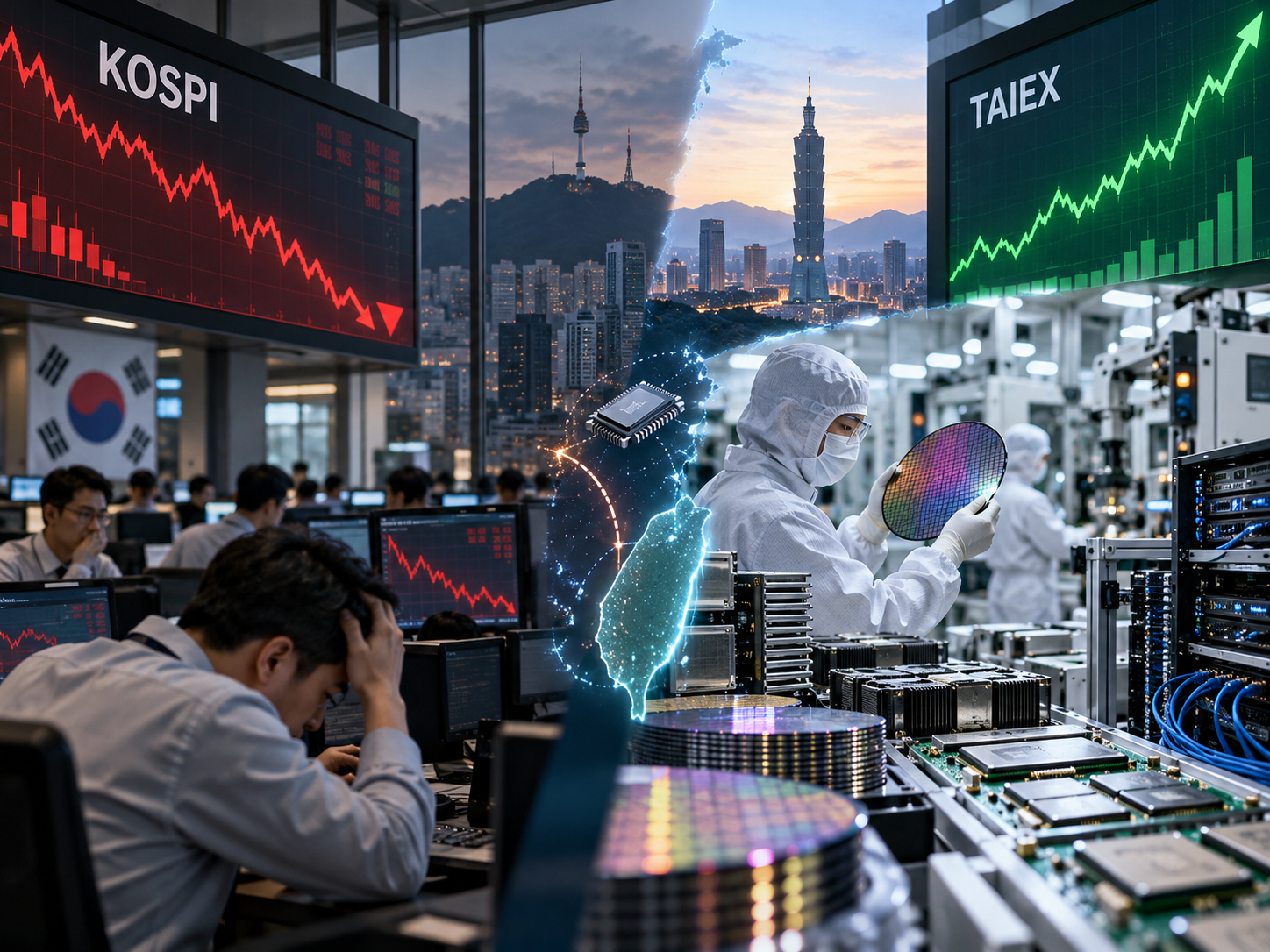
- Taiwan’s Taiex has gained about 7% in the second half and roughly 70% year to date as investors broaden their AI exposure.
- Trading activity in South Korea has fallen sharply, while foreign investors have continued reducing exposure to Korean equities.
- The next phase of the AI trade may favor companies with broader exposure to advanced manufacturing, packaging, servers and networking.
South Korea’s Red-Hot AI Stock Market Has Lost Momentum
South Korea’s stock market has undergone one of the most dramatic reversals of 2026.
The Kospi began the year as the world’s hottest major stock benchmark, powered by soaring enthusiasm for artificial intelligence and strong profits from the country’s dominant memory-chip manufacturers.
That momentum has since faded.
After leading global markets during the first half of the year, the Kospi has fallen about 24% in the second half.
The decline has transformed South Korea from the strongest major market in the first six months of 2026 into the weakest performer in the second half.
The reversal is striking, but it does not mean the AI trade has collapsed.
Instead, investors appear to be changing where they want their AI exposure.
Kospi Is Still Up More Than 50% in 2026
The scale of South Korea’s earlier rally means the index is still substantially higher for the year.
Even after the recent decline, the Kospi remains more than 50% above where it began 2026.
That highlights how aggressive the earlier AI-driven surge had become.
South Korean stocks benefited heavily from investor enthusiasm surrounding memory chips, which are critical components in servers and computing systems used for artificial intelligence.
But the market’s concentration in a handful of semiconductor companies also made the rally vulnerable to a reversal.
Once investors began questioning whether memory-chip earnings growth could continue at the same pace, selling accelerated.
Samsung and SK Hynix Dominated the AI Rally
Much of the Kospi’s performance came from two companies.
Samsung Electronics and SK Hynix emerged as some of the biggest stock-market winners of the artificial intelligence boom.
Both companies benefited from strong demand for memory products used in AI servers and data centers.
Rising memory prices also helped drive earnings sharply higher.
The problem is concentration.
Samsung and SK Hynix together represent more than half of the Kospi.
That means the performance of the entire South Korean benchmark is unusually dependent on one segment of the semiconductor market.
When memory-chip stocks rise, the Kospi can outperform dramatically.
When they weaken, the entire index can come under pressure.
Strong Earnings Are No Longer Enough
One of the clearest signs that investor sentiment has changed came from Samsung Electronics.
The company recently forecast a nearly ninefold increase in quarterly operating profit.
Under normal circumstances, that kind of earnings growth might generate significant enthusiasm.
Instead, Samsung shares fell for two consecutive trading sessions.
That reaction suggests investors are no longer focusing only on current profits.
They are also asking whether those profits are sustainable and whether other parts of the AI hardware supply chain offer better long-term opportunities.
Investors Are Looking Beyond Memory Chips
The shift began before the recent selloff.
Analysts had already begun questioning whether the next stage of the AI boom would continue benefiting memory-chip producers as strongly as it did during the first phase.
In July, analysts at GlobalData.TS Lombard argued that much of the earnings improvement at Korean memory-chip makers had been driven by higher chip prices.
That can produce dramatic profit growth when the market is strong.
But pricing cycles can also reverse.
By contrast, companies such as Taiwan Semiconductor Manufacturing Company and Japanese semiconductor-equipment manufacturers rely more heavily on advanced manufacturing capabilities and specialized process technology.
Those advantages may offer investors a more durable growth story.
Taiwan Is Emerging as a Major Winner
Taiwan appears to be benefiting from that shift.
The Taiex has gained around 7% in the second half of the year.
That has pushed its total 2026 gain to approximately 70%.
Unlike South Korea’s market, which is heavily concentrated in memory-chip companies, Taiwan provides investors with exposure across multiple parts of the AI hardware ecosystem.
That includes:
- Advanced semiconductor manufacturing
- AI chip packaging
- Servers
- Networking equipment
- Electronics manufacturing
- AI infrastructure components
That broader exposure could make Taiwan more attractive to investors who still believe in the AI boom but want to diversify beyond memory chips.
TSMC Gives Taiwan a Strategic Advantage
Taiwan Semiconductor Manufacturing Company is central to the country’s investment story.
TSMC produces some of the world’s most advanced semiconductors for major technology companies.
Its position allows investors to gain exposure to demand from multiple AI-chip designers rather than relying on a single product category.
Advanced manufacturing has become increasingly important as AI processors require more sophisticated production techniques.
Packaging technology is also becoming critical because companies increasingly combine multiple chips into advanced systems.
Taiwan’s semiconductor ecosystem offers exposure to both areas.
That creates a different investment profile from South Korea’s memory-heavy market.
Taiwan Outperformed South Korea Sharply in the Third Quarter
The performance gap became particularly visible during the third quarter.
Taiwan’s Taiex gained nearly 4%.
South Korea’s Kospi fell more than 19%.
That created a performance difference of more than 23 percentage points in a single quarter.
The divergence illustrates how investors are rotating within the AI theme rather than abandoning it entirely.
Capital appears to be moving toward markets with broader exposure to advanced chip manufacturing and infrastructure.
South Korea’s July Selloff Was Historic
The Korean market’s reversal has also been extraordinarily volatile.
The Kospi plunged 22% in July.
That was its worst monthly decline since the 2008 global financial crisis.
The month ended with an equally dramatic reversal.
On the final trading day of July, the index jumped 18%, marking its largest single-day gain on record.
These swings were severe enough to trigger multiple market-wide circuit breakers.
Such volatility suggests that speculative positioning had become extremely aggressive.
Leveraged Bets Amplified the Market Swings
Leveraged investment products appear to have contributed to the volatility.
Many investors had increased exposure to semiconductor stocks through leveraged single-stock exchange-traded funds.
These products magnify daily moves in individual stocks.
That can produce large gains when shares rise.
It can also accelerate losses when markets reverse.
As chip stocks became increasingly volatile, leveraged positions amplified those movements.
South Korean regulators subsequently tightened rules governing leveraged single-stock ETFs amid concerns that the products were fueling speculation.
Retail Investors Felt the Pain
The selloff also became a major cultural event in South Korea.
Younger investors took to social media with memes and dark humor about the losses in their portfolios.
That response reflected how widely the AI-stock rally had attracted retail participation.
The earlier boom created expectations that memory-chip companies could continue delivering exceptional returns.
The sudden reversal showed how quickly sentiment can change when a crowded investment theme loses momentum.
Trading Activity Has Fallen Sharply
The enthusiasm that powered South Korea’s market earlier in the year has cooled dramatically.
Stock-market turnover has fallen approximately 70% from its late-May peak.
Foreign investors have also continued pulling capital from Korean equities.
Lower trading activity suggests that speculative interest has weakened significantly.
It may also indicate that investors are waiting for greater clarity on the next stage of the semiconductor cycle before rebuilding positions.
The AI Trade Is Changing, Not Disappearing
The most important point is that investors do not appear to be abandoning artificial intelligence.
Instead, the trade is evolving.
The first stage of the AI boom rewarded companies directly exposed to surging demand for computing components.
Memory chips were among the biggest beneficiaries.
The next stage may be broader.
Investors are increasingly looking across the entire AI hardware supply chain.
That includes companies involved in manufacturing, packaging, networking, servers and data-center infrastructure.
This shift can explain why South Korea has weakened while Taiwan continues to perform strongly.
Memory Chips Still Matter
The shift away from South Korea does not mean memory chips have become unimportant.
AI systems require enormous amounts of high-performance memory.
Samsung and SK Hynix remain major players in the global semiconductor industry.
Their products are deeply embedded in AI infrastructure.
The concern is valuation and durability rather than relevance.
Investors are asking whether the strongest period of memory-chip pricing has already been reflected in earnings and share prices.
If memory prices continue rising, Korean chipmakers could regain momentum.
If pricing weakens, earnings growth could slow rapidly.
Taiwan Offers Broader AI Exposure
Taiwan’s advantage is diversification within the AI ecosystem.
A single investment market provides exposure to multiple stages of semiconductor production.
That reduces dependence on one specific technology cycle.
TSMC benefits from advanced-chip demand.
Packaging companies benefit as processors become more complex.
Server manufacturers benefit from data-center expansion.
Networking companies benefit from the enormous infrastructure required to connect AI systems.
This broader ecosystem may explain why investors have continued allocating capital to Taiwan even as enthusiasm for Korean memory stocks cools.
What Investors Should Watch Next
Several factors could determine whether South Korea’s market recovers.
The first is memory-chip pricing.
If prices remain strong, Samsung and SK Hynix could continue generating substantial profits.
The second is foreign investor flows.
Continued selling by international investors could keep pressure on Korean equities.
Trading activity will also be important.
A recovery in market turnover could signal renewed confidence.
Finally, investors should watch whether the AI trade continues broadening across semiconductor supply chains.
If that trend persists, Taiwan and other markets with diversified AI hardware exposure could continue attracting capital.
South Korea Remains a Major AI Market
Despite the recent selloff, South Korea remains one of the world’s most important semiconductor economies.
Samsung Electronics and SK Hynix are critical suppliers of memory technology to the global technology industry.
The Kospi’s year-to-date gain of more than 50% also shows how much value investors have already assigned to that position.
The current correction therefore represents a reassessment rather than a complete rejection of the Korean AI story.
Investors are simply becoming more selective.
Conclusion
South Korea’s stock market has experienced one of the most dramatic reversals of the 2026 AI boom.
After becoming the world’s best-performing major market in the first half of the year, the Kospi has fallen about 24% in the second half.
Its dependence on Samsung Electronics and SK Hynix helped fuel the original rally, but that same concentration has made the index vulnerable as investors question how sustainable memory-chip earnings growth will be.
The artificial intelligence trade itself remains alive.
What is changing is where investors want exposure.
Taiwan has emerged as one of the clearest beneficiaries because its semiconductor ecosystem spans advanced manufacturing, packaging, servers and networking rather than relying primarily on memory chips.
That shift could define the next stage of AI investing.
The first phase rewarded companies selling essential components into the boom.
The next phase may favor markets and companies positioned across the entire AI infrastructure chain.