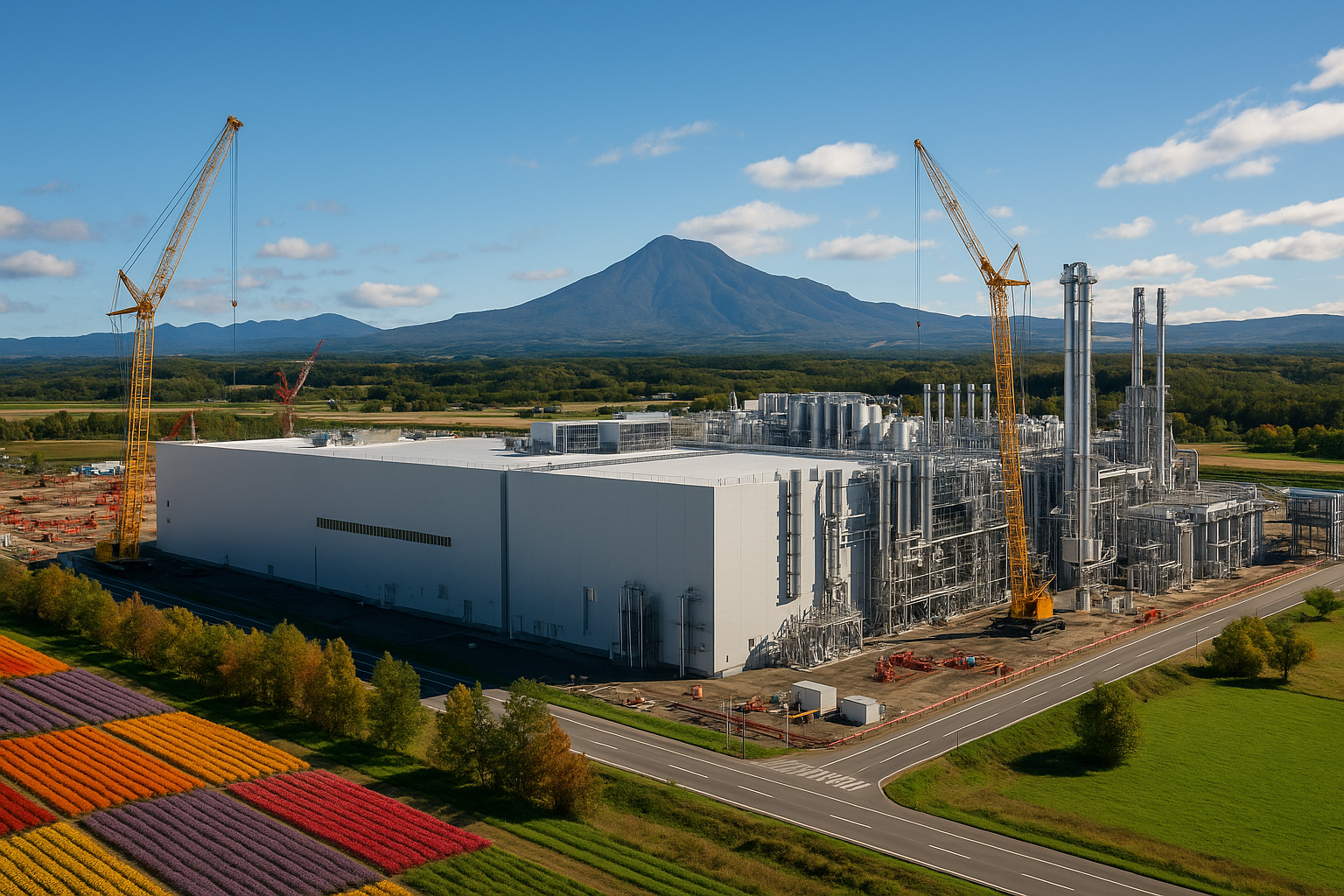
Key Highlights
• Japan is investing billions to transform Hokkaido—traditionally an agricultural and tourism region—into a global hub for advanced semiconductor manufacturing.
• Government-backed chipmaker Rapidus has achieved a major breakthrough: successful production of 2nm prototype chips, placing Japan back in competition with TSMC and Samsung.
• The Japanese government has invested $12B into Rapidus, with additional backing from major corporations such as Toyota, Sony, SoftBank, and a crucial technology partnership with IBM.
• Japan aims to revive its once-dominant semiconductor industry, which manufactured over half of the world’s chips in the 1980s, but now produces just 10%.
• Chitose, Hokkaido was chosen for the mega-fab due to abundant water, stable electricity, land availability, and relatively lower earthquake risk
Introduction: Japan’s Most Ambitious Tech Push in a Generation
Hokkaido—long known for its dairy farms, ski resorts, and flower fields—is being reimagined as the center of Japan’s semiconductor revival. The government is launching a massive economic gamble: transforming the quiet northern island into a cutting-edge chip manufacturing hub capable of producing 2-nanometre semiconductors, the most advanced in the world.
This transformation is driven by Rapidus, a young but heavily backed company created to bring semiconductor production back to Japan after decades of decline. The stakes are enormous. So are the potential rewards.
Rapidus: The Unexpected Challenger in the Global Chip Race
Few had heard of Rapidus before Japan announced a multibillion-dollar plan to build an ultra-advanced chip foundry in Chitose, southwest Hokkaido.
Who is backing Rapidus?
- Japanese government: $12 billion invested
- Corporate giants: Toyota, Sony, SoftBank, NTT and others
- Technology partner: IBM, providing essential know-how
Rapidus achieved a breakthrough in 2025: successfully producing prototype 2nm transistors, placing Japan back in a race dominated by:
- TSMC (Taiwan)
- Samsung (South Korea)
- Intel (US), which is skipping 2nm entirely
Rapidus CEO Atsuyoshi Koike says the company’s competitive advantage will not be mass production, but speed:
“We can produce and deliver custom chips three to four times faster than anyone else.”
Why Hokkaido? The Surprising Choice for a Semiconductor Hub
Hokkaido seems like an unlikely place to manufacture the world’s most advanced chips. Yet it offers strategic benefits:
1. Abundant water supply
Chip fabrication requires enormous amounts of water—Hokkaido has vast resources.
2. Reliable, clean electricity
Crucial for stable production.
3. Low earthquake risk
Unlike much of Japan, Hokkaido’s seismic activity is comparatively moderate.
4. Room for expansion
Massive land availability allows multiple fabs, supplier factories, and research institutions.
Even the Rapidus facility will be covered in grass, blending with the region’s natural environment.
The Doubts: Can Japan Really Catch Up?
Despite excitement, experts highlight serious challenges.
1. Massive funding gap
Japan has committed billions, but the expected cost to scale production is ¥5 trillion ($31.8bn).
Rapidus has only a fraction of that.
2. Lack of advanced manufacturing experience
Japan once dominated semiconductors—but hasn’t produced cutting-edge chips since the 1980s.
3. Fierce global competition
TSMC and Samsung have:
- Decades of mass-production expertise
- Existing clients like Apple, Nvidia, Qualcomm
- Efficient, scalable infrastructure
4. Severe talent shortage
Japan needs 40,000 semiconductor engineers.
Rapidus must rely heavily on:
- Foreign workers
- Partnerships with Hokkaido University and others
Japan’s public resistance to immigration could complicate this.
A Return From the “Lost Decades”?
Japan’s semiconductor glory peaked in the 1980s, when it produced more than half of the world’s chips.
Today? Only 10%.
This decline was driven by:
- US-Japan trade tensions
- Lack of subsidies
- Slow adaptation to global competition
Now the government is dramatically reversing course:
Japan’s semiconductor funding (2020–2024): $27 billion
More aggressive, relative to GDP, than the US CHIPS Act.
In 2024, Japan announced an additional $65 billion AI and semiconductor package—its most ambitious industrial investment in decades.
Building the Ecosystem: Japan Attracts Global Chip Players
Hokkaido’s transformation mirrors Kyushu’s recent semiconductor boom, where TSMC opened new facilities, injecting:
- Thousands of tech jobs
- Higher regional wages
- Major investments in infrastructure
Similarly, Hokkaido is now attracting:
- ASML
- Tokyo Electron
- Smaller chip suppliers
Other major chip investments across Japan include:
- Micron: $3.63bn for Hiroshima
- Samsung: R&D center in Yokohama
- Kioxia, Toshiba, ROHM: expanded fabs with state support
Why Japan Is Making This High-Stakes Bet
1. National security concerns
Geopolitical tensions between China and Taiwan raise fears about the stability of global chip supply.
2. Rising global demand
AI, electric vehicles, robotics, and cloud computing all require advanced semiconductors.
3. Pressure from automakers
Japan’s car industry wants domestic chip capacity after pandemic-era shortages crippled production.
4. Desire to reclaim technological leadership
Tokyo wants to restore Japan’s influence in the global tech economy.
Conclusion: A Bold Gamble With Global Consequences
Japan’s plan to turn Hokkaido into a semiconductor powerhouse is one of the most ambitious industrial revivals undertaken by any advanced economy in decades. If Rapidus succeeds in mass-producing 2nm chips by 2027, Japan could re-enter the top tier of global chipmakers.
Failure could leave the country with billions in sunk costs and no competitive chip industry.
But for Japan—facing an aging population, slowing growth, and rising geopolitical risks—the gamble may be worth it.