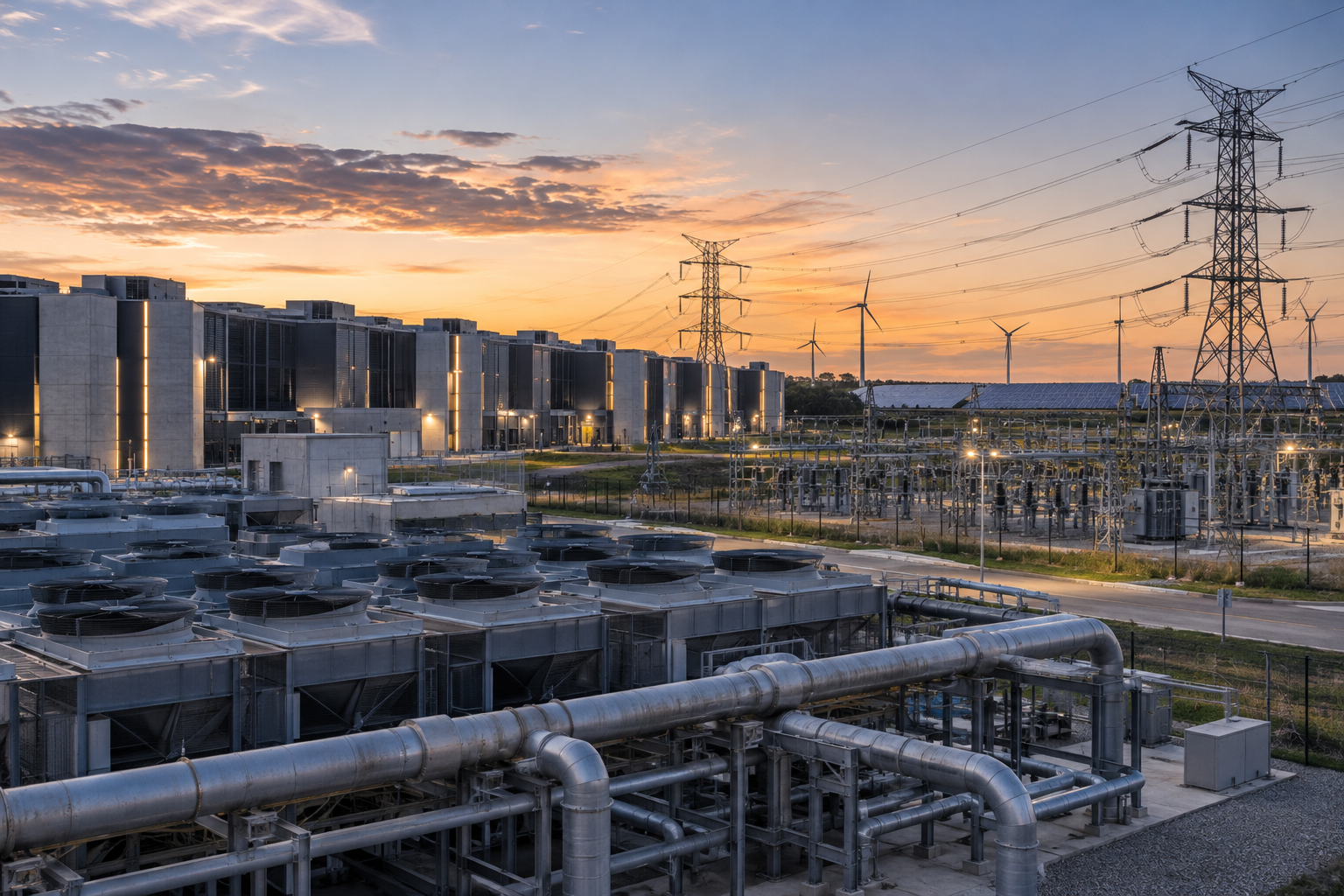
US electricity consumption is expected to reach unprecedented levels in 2026 and 2027, driven largely by the rapid expansion of artificial intelligence data centers and increasing electrification across residential, commercial, and industrial sectors, according to the US Energy Information Administration (EIA).
In its November 10 Short-Term Energy Outlook, the agency projected that electricity demand would increase from a record 4,216 billion kilowatt-hours (kWh) in 2025 to 4,306 billion kWh in 2026 and 4,370 billion kWh in 2027.
If the forecast materializes, 2026 will mark the third consecutive year of record US electricity consumption, highlighting the growing pressure that technological development and changing energy needs are placing on the country’s power infrastructure.
The projections come as technology companies accelerate investments in artificial intelligence infrastructure, requiring increasingly large amounts of electricity to operate data centers and advanced computing systems.
AI Data Centers Drive Growing US Electricity Consumption
The rapid expansion of artificial intelligence has emerged as one of the principal drivers of electricity demand in the United States.
Data centers require substantial amounts of electricity to power servers, networking equipment, and cooling systems. As companies expand their AI capabilities and deploy increasingly sophisticated computing infrastructure, their energy requirements are expected to continue growing.
The EIA identified data center development as a major contributor to rising electricity consumption, alongside the increasing use of electricity for residential and commercial heating, transportation, and industrial activities.
According to the agency’s projections, electricity sales in 2026 will reach approximately 1,546 billion kWh for residential customers, 1,557 billion kWh for commercial consumers, and 1,061 billion kWh for industrial users.
Residential and commercial consumption are expected to surpass their previous records, established in 2025, while industrial electricity sales will remain slightly below their historical peak of 1,064 billion kWh recorded in 2000.
The growing importance of data centers reflects a broader transformation in the US energy market, as digital infrastructure becomes an increasingly significant source of electricity demand.
Renewable Energy Gains Ground as Coal Generation Declines
Despite rising electricity consumption, the EIA expects the composition of US power generation to continue shifting toward renewable energy sources over the next two years.
The agency projected that renewables will account for approximately 25% of total electricity generation in 2026, increasing to 28% in 2027, compared with roughly 24% in 2025.
Meanwhile, coal’s share of electricity generation is expected to decline from 17% in 2025 to 15% in both 2026 and 2027.
Natural gas is projected to remain the largest individual source of electricity generation, maintaining a 40% share in 2026 before declining slightly to 39% in 2027.
Nuclear energy is expected to maintain a relatively stable contribution, accounting for approximately 18% of US electricity generation throughout the forecast period.
These projections suggest that renewable energy will play an increasingly important role in meeting additional electricity requirements, although natural gas and nuclear power will remain significant components of the country’s energy mix.
The transition also highlights the challenges facing US electricity infrastructure as utilities attempt to accommodate growing demand while adjusting their generation portfolios.
Natural Gas Demand Shifts Across Residential, Industrial, and Power Sectors
The EIA also projected changes in natural gas consumption across different segments of the US economy.
For 2026, natural gas sales to residential consumers are expected to decline to approximately 12.2 billion cubic feet per day (bcfd), while commercial consumption is forecast to reach 9.4 bcfd.
In contrast, industrial natural gas consumption is projected to reach 23.8 bcfd, while consumption for electricity generation is expected to increase to 37.4 bcfd.
The figures illustrate the growing importance of natural gas in supporting electricity production, particularly as power demand increases alongside the expansion of data centers and other energy-intensive industries.
Although renewable generation is expected to capture a larger share of the electricity market, natural gas will continue to provide a substantial portion of the energy required by the US power sector.
AI Expansion Creates New Challenges for the US Power Grid
The expected increase in electricity consumption presents significant challenges for the US energy industry.
The expansion of AI infrastructure requires not only additional generation capacity but also investments in transmission networks, distribution systems, and cooling infrastructure.
Data centers are particularly demanding because they require reliable electricity supplies around the clock. Their growing concentration in certain regions can also create localized pressure on existing power networks.
Research from Lawrence Berkeley National Laboratory, published in its 2025 Data Center Energy Usage Report update, estimates that data centers could account for 11.8% of total US electricity consumption by 2030, although the report identifies a range of possible outcomes.
This growing energy footprint has prompted greater attention to the relationship between technological development, electricity infrastructure, and long-term energy planning.
For utilities and energy producers, the challenge will be to ensure that additional electricity supplies can keep pace with the expansion of AI computing while maintaining reliability and managing costs.
Outlook: AI and Electrification Reshape the US Energy Market
The EIA’s latest projections underscore the increasing relationship between technological innovation and energy consumption in the United States.
As artificial intelligence adoption accelerates and businesses invest in increasingly sophisticated computing infrastructure, electricity demand is expected to remain a major consideration for energy producers, utilities, and policymakers.
At the same time, the projected increase in renewable generation and the declining contribution of coal point to an evolving electricity mix.
The coming years will therefore test the ability of the US power sector to accommodate rapidly growing demand while maintaining a reliable and increasingly diversified energy supply.
With electricity consumption projected to reach 4,370 billion kWh in 2027, the expansion of AI data centers is becoming an increasingly important factor in shaping the country’s energy outlook.